
King Charles the Third Personifies His Class
British state occasions are often condemned and mocked by leftists as ridiculous, and indeed they do appear so to the thinking person. The arcane rituals to which we will be subjected to this Saturday, the endless fawning of the TV anchors, the ridiculous buffoonery of the media commentators and the desperate attempts by establishment figures to drum up enthusiasm in the masses. All seems absurd to anyone who isn’t either a tourist, who is viewing it as a museum piece or someone who has ingested far too much British state propaganda and is taking the whole thing seriously as some king of great “National unity” moment. But for all the strangeness of it the set piece occasions of the British state do serve a purpose and it is to that purpose that we must turn. Britain is the oldest capitalist nation, even if wasn’t the first, and it’s ruling class are long practiced in how to use the institutions of state to further their rule be it either through the use of brute force or (and this is an area they are expert in) how to use different institutions to divide and sub-divide the working class. The monarchy is a uniquely British institution in that its construction in the modern era has been a classic case of the ruling class keep the form but totally changing the content of such an institution.
The monarchy claims its legitimacy from being part of an (almost) unbroken line of monarchs going all the way back to William the Conqueror himself. Of course the parentage of many of these crowned heads has been called into question over the centuries but this has never really been a problem for the ruling class. The mythology doesn’t have to be true for it to serve a purpose after all. The evolution of capitalism in Britain, the breaking down of feudalism over the course of the period between the peasants revolt and the final collapse of the old system in the period the English revolution of 1649-1660, was written about by Marx & Engels on many occasions. In Capital Volume 1 Marx explained how the land reforms of Henry VII marked an evolution of how agriculture was managed moving it further away from the old feudal mode of exploitation towards a much more recognisably capitalist mode. He also wrote about how Henry VII was key in breaking down the old feudal rights of the aristocracy to keep large bodies of armed men. The 15th century in which Henry (the man who defeated Richard III and ended the wars of the roses) and his notorious heir Henry VIII proceeded to centralise power within the office of the monarch, draining power away from the feudal aristocracy. The founding of the Church of England is also part of this process, the shifting of the source of religious authority from the Pope in Rome to the English King was a truly revolutionary act. The looting of the monasteries and the flow of their gold into the Kings treasury and out into the wider economy also helped to generate further growth in capitalist relations as did the distribution of old church land to new owners who came more from merchant backgrounds and (often) not from the traditional aristocracy. This period saw a further building of an autocracy, which was reflected when James I of England & VI of Scotland pushed for a union of the crowns to further concentrate power. James was an ardent advocate of absolutism and the divine right of Kings, as expressed in two books he authored at the time. Absolutism was a product of the decline of the feudal order and the rise of early capitalism in the form of the merchants and bankers in the city of London. The building up of the power of the monarch served that system well as it provided a much needed political stability against the earlier period of turbulence that saw the end of the Plantagenet dynasty. Absolutism became a fetter on capital though in the early 17th century. James and his successor Charles frequently clashed with the bourgeois radicals in the House of Commons over issues of taxation and the ability of the state to declare state monopolies over certain areas of economy. Charles’s declaration of a state monopoly over the wool trade angered many in merchant class and his dismissal of their parliamentary representatives and attempt rule by himself only further stoked this resentment. What we see in the clash between Charles and the parliamentarians, that culminated in civil war, was the product of the rising English bourgeoisie finding that absolutism had become a fetter on their ability to “do business”. The bourgeois revolution that broke was animated by many of the same ideas that were to return to prominence in the later American and French revolutions, that of the sacred rights of the individual, constitutional government and clear legal codes which protected property rights. These were the concerns of the great bourgeois philosophers of the era such as John Locke and reflected the class interests of the rising bourgeoisie.
The revolutionary period in British history (because the events of this time take in all the nations that had made up Britain as well as Ireland) lasts from 1638 (the rebellion of the Scottish Protestants) to the final defeat of the Jacobite counter-revolution in 1745. This is something that bourgeois histories do not readily admit to but has been analysed by Marxists such as Christopher Hill in his work ‘Century of Revolution’, that the revolution in Britain was a process that unfolded over the course of at least a century. The first revolutionary period saw the overthrow of Charles I, his arrest, escape, recapture, subsequent trial and execution. There followed the period known as ‘The Commonwealth’ which saw Cromwell install himself and run a revolutionary bourgeois dictatorship. This period of dictatorship came about because the bourgeois were unable to agree upon a system of government so Cromwell became ‘Lord Protector’ in order to provide stability and when he died in 1660 the consensus amongst the ruling class was to offer Charles II the chance to restore his crown. This was not a simple restoration though, the revolutionary period has inflicted a fatal blow on the idea of absolutism and the concept of the King being appointed by god. After all, a king had been tried and executed and the sky had not fallen in. More seriously though the English ruling class wanted a stable government that would respect be reflective of and would work to protect and further their class interests. If Charles II would prove to be a willing figurehead who was content to largely let the rising capitalist class run the state then there was no objection from most of the ruling class as to the restoration of the House of Stuart to act as an example of a constitutional monarchy. Charles proved (mostly) willing to act in such a manner. The problem came when the throne passed to his brother James, after Charles failed to provide a legitimate heir, though he had many children who ‘illegitimate’. The throne passed to his younger brother James. The convention tale told here by bourgeois historians is that his subsequent overthrow was a matter of religion with James (a Roman Catholic) trying to restore the position of the Church of Rome in England. The reality though is that the ruling class feared James was too much like his father and grandfather when he clashed openly with parliament. It was for this reason that the English ruling class struck a bargain with William of Orange (husband of Mary, James’s sister) to take the throne and solidify their new constitutional monarchy.
The system that was born from the period of William and Mary has been retained to this day. The monarchy was recreated but all power, in practice, passed to parliament and later to the office of Prime Minister. The monarch got to do the formalities of appointing dismissing governments but now the crown was to serve the needs of the bourgeoisie and never the other way around. The monarchy and aristocracy became incorporated into the bourgeoisie. Even though tension remained between the landowners and the capitalists up until the final victory of the industrial capitalists over the landowners with the abolition of the corn laws, there was no question of a return to feudalism or absolutism. The old institutions of feudalism had become accustomed to serving the new ruling class.
In the 19th century the constitutional scholar Walter Bagehot observed that the British constitution was divided into two sections the “dignified and the efficient”. Bagehot stated thus:
‘one to excite and preserve the reverence of the population’ and the other to ‘employ that homage in the work of government’
Walter Bagehot – The English Constitution 1867
Bagehot was writing at a time when some bourgeois intellectuals at least were more honest about the purpose of these institutions. The monarchy in Britain became a means to unite at least the petit-bourgeoisie and certain sections of the working class behind the British state. The “efficient” part of the constitution (as Bagehot saw it) was to be the cabinet, parliament and civil service where the actual business of governing went on. The successful “bourgeoisification” of the monarchy in the 19th century later led the great Irish revolutionary James Connolly to observe:
when the eyes of the world are turned upon that City of London, when Capital and its cringing slaves are united in adoration of the monarch who has been successful in uniting in his person, all the baser attributes of the mediaeval monarch and the modern stockjobbing capitalist;
James Connolly – Coronation of King Edward VII
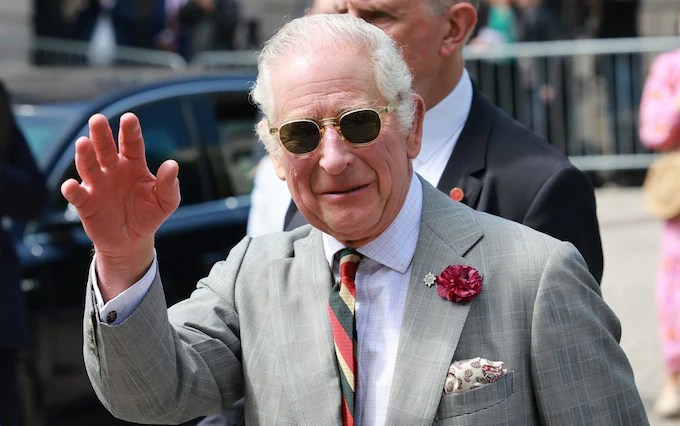
The monarchy has evolved with British imperialism and not just in the titles they hold, such as Emperor of India, but with the way in which they very much employees of the imperialist system. Remember that the now disgraced Andrew Windsor was a trade envoy under the Labour government of Blair & Brown and the new King has had a very long association with Saudi Arabia and the Gulf monarchies. As British imperialism has declined though so have it’s institutions in terms of their ability to command the respect of the population. If the purpose of the monarchy was to be “dignified” then the very public disgraces of King Charles are anything but that, from his failed marriage to his close friendship with celebrity mass rapist Jimmy Saville, the new King has a distinctly soiled reputation. For all the PR job that the bourgeois press have been trying to give him over the last few months his long history of disgrace and his tendency to publicly associate himself with the Malthusian climate change reveal a man who is incapable of being the “dignified” face of British imperialism. It is said that when history demands a figure to fit the moment then one does appear. In the case of King Charles III he is perhaps the ideal figurehead for a stagnating British capitalism. A buffoonish figure, lost in a world of wealthy delusions, unable to mask his contempt for the working class and who has spent a lifetime publicly serving imperialism. There is no better way to sum up what out attitude towards such a creature should than that which Connolly stated in 1902 when writing of Charles’ ignoble ancestor:
we also in imagination hasten thither in order to offer to King Edward, in the name of ourselves and our class, the only homage we owe him – OUR HATRED.
James Connolly – The Coronation of King Edward VII
 Marx Engels Lenin Institute
Leave a comment