
SPEECH BY VLADIMIR SERGEEVICH BUSHIN AT THE VII CONGRESS OF RUSSIA WRITERS
Today marks the centenary of the birth of the great Soviet Russian writer Vladimir Sergeevich Bushin. He was a veteran of the Great Patriotic War and later a writer and journalist. An ardent Communist and defender of the legacy of Stalin he wrote several books exposing the lies of the treacherous fraudster Alexander Solzhenitsyn. In honour of Bushin’s centenary we publish this translation of his speech at the Russian writers congress of 1990 where he (in very witty terms) attacked Gorbachev, Yeltsin, Yakovlev and the other counter revolutionaries.
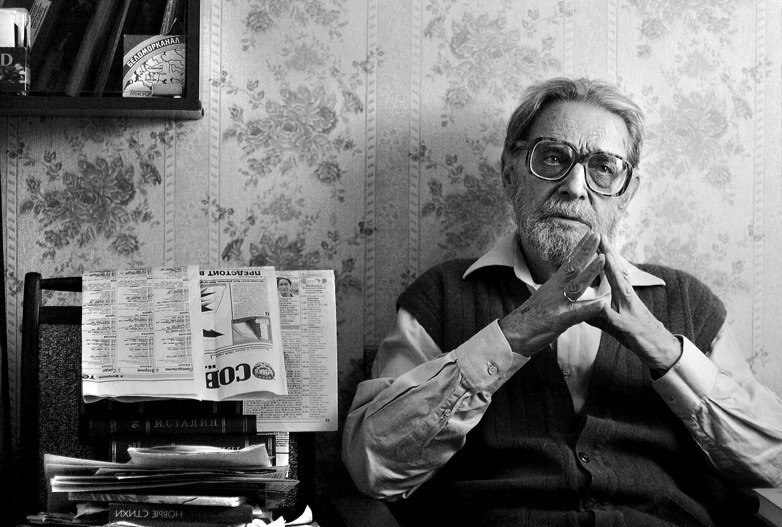
December 14, 1990 Moscow. Central Theater of the Soviet Army.
Since you and I, dear comrades, are all inveterate pluralists here, and not only in the sphere of content, but, I hope, also in form, I would consider it possible in my speech to directly address our President.
Dear Mikhail Sergeevich!
The seventh congress of Russian writers ends today. In your last speeches and speeches, in particular, during a meeting with cultural figures on November 28, 1990, you suddenly began to remember that you are Russian. And one grandfather, who was dispossessed, was Russian, and another grandfather, who was in prison, was also Russian. (Movement in the hall). Therefore, our congress, it seems, should interest you not only as the leader of the country.
All four days we worked at the Central Theatre of the Soviet Army. This involuntarily brought to mind various kinds of memories and considerations of a military nature. In particular, some of us remembered that you have the rank of colonel. (Movement in the hall).
This title, as it recently became known from the military press (VIZH, No. 10, 1990, p. 95) , you received in 1978, when Brezhnev and Suslov took you, a young and energetic builder of “barracks socialism,” as you now put it yourself , from Stavropol to Moscow and made Secretary of the Party Central Committee for Agriculture. Why the Secretary of Agriculture needs a colonel’s rank is known only to such an expert on rural life as People’s Deputy Yuri Chernichenko, and to such an expert on Central Committee morals and customs as People’s Deputy Fyodor Burlatsky – a famous Khrushchev-Brezhnev speechwriter.
But be that as it may, the fact remains a fact. And one must think that then, twelve years ago, you were given an overcoat and a jacket with shoulder straps, a hat, boots with spurs and binoculars. The last item was simply necessary for you: with its help you could better see how the crops were ripening in the fields of the country and how the Food Program, which you had led for seven years, was being implemented. (Laughter in the audience).
Throughout the entire work of the congress, we have been waiting for good news from you, the high Russian leader. And we would not be surprised, but only delighted if on one of these four days the front door swung open and you, creaking boots, jingling spurs, adjusting your holster with your hand, walked into the presidium and sat next to retired colonel Mikhalkov. (Noise in the hall, laughter). Alas, we did not wait for your arrival or even news. But we are not offended, we understand how much you have to do. Just these days there was a congress of power engineers – it was necessary to send them a government telegram. Armand Hammer, Russia’s precious sadman, died – it was necessary to express condolences. Some scoundrel wounded the famous journalist of Leningrad television, Alexander Nevzorov, in the shoulder – it was impossible to leave this without your high attention, just as in your time you, it seems, did not ignore hundreds of unknown victims of Sumgait, Baku, Osh, Fergana, Namangan, Dubossary: And then, apparently, you were unable to tear yourself away from Yevgeny Yevtushenko’s wonderful book “Politics is the Privilege of All,” which you spoke about so heartfeltly, before finishing it, at the last meeting with artists. Apparently, the book by the helmsman of our poetry made a much greater impression on you than the letter of 74 writers about the troubles of the Motherland (later hundreds, thousands of authors joined it), to which you did not respond. (Movement in the hall).
In a word, no, we were not offended. Some people on the sidelines of the congress said that they should have sent you a personal invitation. But others think it is useless. The miners recently invited you to their congress, but you still couldn’t please them with your presence: you had to receive the Prime Minister from Luxembourg, study Solzhenitsyn’s article “How can we organize Russia” one more time, talk with the charming Jane Fonda: In short, Things were, as always, to capacity.
Yes, I repeat, we are not offended. Moreover, we take this opportunity to sincerely congratulate you on your Nobel Prize. And the fact that the famous MFA poet Anatoly Kovalev received it on your behalf in Oslo makes us especially happy. We regard this as an expression of special confidence in the Russian Writers’ Union. (Laughter in the audience).
At the same time, we also congratulate you on the Indian Indira Gandhi Prize, the Irish Peace Convention Prize, the Spanish Prince of Asturias Prize
, the Italian Fiuggi Prize, and the German Otto Hahn Gold Medal. (Movement in the hall). Now, Colonel, you have more international awards than Marshal Brezhnev had Gold Stars. (Laughter in the audience). Congratulations on that too. But we should note one strange pattern: the worse the situation in our country, the higher and more prestigious bonus you are given. Why did it happen?*
In the glow of awards that are pouring down on you from behind the “hillock”, it looks completely incomprehensible and extremely upsetting, such as, for example, the facts that became known at the last Plenum of the CPSU Central Committee – the speech of A.S. Savkin and others, as increasingly louder and more numerous voices expressing no confidence in you and even demanding your resignation. And at the last congress of deputies of Russia, the writer V. Belov, well-known throughout the country, said: “In the cruel, exhausting political struggle, our leaders think little about the Russian people. And you, deputies, must, are obliged to nominate new energetic, intelligent and young leaders from among yourselves>. In essence, this is the same demand that you, Yeltsin, Yakovlev, Khasbulatov and Starovoytova resign.
* A few days after our congress, M.S. Gorbachev received another award – the “Peace Award” of the World Methodological Council of Religious Organizations. – V. Bushin.
Some spiteful critics go so far as to call perestroika, your favorite and unpredictable brainchild, a catastrophe, counter-perestroika and even counter-revolution (see <LR>, No. 51, 1990, p. 10). What is it that they can do? It turns out that Yakovlev, the best ideologist of all times and peoples, is counter-revolutionary No. 1, you are counter-revolutionary No. 2, Shevardnadze is No. 3, Nenashev is No. 4, Yeltsin, who always emphasizes that he differs from you only tactically, is No. 5? .. Merciful God, and all this is said by people who don’t even have a medal “For saving drowning people”! (Explosion of laughter).
It should be noted that in this situation people look very strange, including individual writers who, quite recently, on the pages of Moscow News (No. 52, 1988) swore friendship and loyalty to you – Grigory Baklanov, Alexander Gelman, Daniil Granin , Elem Klimov, academician Sagdeev, Mikhail Ulyanov. Remember their collective “Open Letter” on the eve of 1989? They wrote: “In three months we will have to elect those into whose hands all state power will be transferred. We don’t yet know which names will be on the ballot. We know only one thing for sure: each of us will vote for you in the spring of 1989:> <Even if M.S. Gorbachev’s candidacy is not on the ballots that we receive:> Just think, the election campaign has not yet begun, no candidates have been nominated, and they were already in a hurry, already assuring in six languages of the world of their love, signing a signature of their devotion, already rushing for a frying pan to treat you to scrambled eggs as soon as that chicken that is still in the nest lays an egg. (General laughter).
So, isn’t it strange that now, when you are so sharply criticized, when they demand your resignation, these fussy chickens are deafly silent? Let’s say Roald Sagdeev, our academician in export performance, is now overseas, busy strengthening Soviet-American friendship through a somewhat late marriage with an American millionaire. But why are Baklanov and Gelman silent? Why don’t Granin and Ulyanov raise an angry voice in your defense at the Congress of People’s Deputies? Well, okay, Granin, his hero Timofeev-Ressovsky could live in Germany during the war and work for the Nazis. But Ulyanov! All his life he played the role of Marshal Zhukov in films. The same one who at one time defended and saved Khrushchev. Where, one might ask, is the connection between art and life in twice-national Ulyanov? (Laughter, applause).
The academicians you favored are also silent: Arbatov, Aganbegyan, Goldansky, Emelyanov, Zaslavskaya: Contrary to your hopes, how unpromising they all turned out to be! (laughter in the audience).*
*Now we know that they all remained cowardly silent on December 17, when the Chechen Sazhi Umalatova, a foreman from a machine-building plant, rose to the podium of the congress and said: “M.S. Gorbachev has no moral right to continue leading the country. You cannot demand more from a person.” , than he can. Mikhail Sergeevich did everything he could. He destroyed the country, pitted peoples against each other, and sent a great power around the world with an outstretched hand:
Dear Mikhail Sergeevich! The people believed you and followed you, but they were cruelly deceived. You bring destruction, collapse, hunger, cold, blood, tears, death of innocent people: You must leave for the sake of peace and tranquility of our long-suffering country.
Amid the applause of the West, M.S. Gorbachev forgot whose president he was and absolutely did not feel the pulse of the country: The country was overwhelmed by immorality, anger, and crime. The country is dying: Therefore, I ask that the first item on the agenda of the Council be my proposal of no confidence in M.S. Gorbachev .”
As parliamentary observer M. Buzhkevich wrote in Pravda the next day, “in complete silence from the audience, Sazhi Umalatova left the podium.” The silence of the members of the Presidential Council and the Politburo was expressive. But the silence of the Granin and Ulyanov, Arbat and Goldan, Emelyanov and Zaslavsky thundered loudest throughout the whole country.
On the last day of the congress, Leonid Ivanovich Sukhov, a driver from Kharkov, will say from the podium: “There is no need, comrades, to scold Deputy Umalatova. We should be proud of her. We all need to learn from her. It was very difficult for her to tell her what we heard, but otherwise it would cease to be true . ” And no one objected to this. Only a chuckle was heard somewhere in the hall. Most likely, it was Zaslavskaya who laughed:
However, Mikhail Sergeevich, you hardly have the right to be offended by all these people’s chicken-feeders who do not protect you. After all, in six years of your leadership, you yourself have not protected anyone. Since it behooves the Secretary General, the President, the Commander-in-Chief, you did not protect from slander and slander neither the party that raised you to the highest peak, nor the army that in 1943 saved your family from occupation and enslavement, nor the Russian people themselves, blood which flows in your veins.
You did not even protect your closest work comrades – neither Ligachev, nor Ryzhkov, nor Afanasyev, nor even the same Yakovlev, whom you publicly called Sasha on Ivanovo Square in the Kremlin. Of course, each of them deserves criticism for something, but it’s not for nothing that Taras Bulba (by the way, like you, Colonel) said: “There is no bond more sacred than comradeship!.. There have been comrades in other lands, but such as in Russian earth, there were no such comrades!” (Stormy applause). No, it was not for nothing that the non-party Colonel Bulba said so. (Applause).
Do you remember how Ostap, who was captured, was executed? “The executioner tore off his old rags: they tied his hands and feet into specially made machines . ” It was in vain that the king and many knights, enlightened in mind and soul, imagined that such cruelty of punishment could only fuel the vengeance of the Cossack nation. But the power of the king and other opinions was nothing compared to the disorder and daring will of the state magnates, who, with their thoughtlessness, the incomprehensible lack of any foresight, childish pride and insignificant pride, turned the Diet into a satire on government. Aren’t you familiar, Mikhail Sergeevich, with all this in today’s prose: cruelty, vengeance, thoughtlessness, short-sightedness, insignificant pride and, finally, the Diet, turned into a satire on government?
“Ostap endured torment and torture like a giant. Neither a scream nor a groan was heard even when they began to break his arms and legs, when their terrible grunt was heard among the dead crowd of distant spectators: Taras stood in the crowd, with his head down and At the same time, he proudly raised his eyes and only said approvingly: “Good, son, good!”
But when they brought Ostap to his last death throes, it seemed as if his strength began to give in: “Oh,” he moved his eyes around him, “God, all the unknown, all the alien faces! If only someone close to him had been present at his death! He would not like to hear the sobs and contrition of a weak mother or the insane cries of his wife, he would now like to see a firm husband who would refresh him with a reasonable word and console him at his death. And he fell with strength and exclaimed in spiritual weakness:
– Father! Where are you? Can you hear?
– I hear! – rang out among the general silence, and the entire million people shuddered in an instant” (A flurry of applause). If the colonel’s thunderous “I hear!” had been heard in response, then the entire three hundred million people would have shuddered in an instant and perked up. But there is no answer, and only dead words fly over the country, as if from Andriy’s lips: <consensus>, <privatization>, <sponsors>: (Stormy applause).
Here, in the theater of the Soviet Army, we also remembered with gratitude, Mikhail Sergeevich, that from your fees you donated a fair amount for the monument to Vasily Terkin, the literary hero of the Great Patriotic War. From the Izvestia article, cheerfully entitled “The author of the intrepid Chonkin is again a Muscovite,” we learned that you took an active part in the everyday affairs, in particular, the apartment affairs, of the creator of this same Chonkin, another literary hero of the war.
So, with one hand for Tyorkin, with the other hand for Chonkin. Wonderful! After this, who can accuse you of being one-sided! I’d like to think, seeing such your breadth, that now you will help your Politburo comrade I.K. Polozkov, to whom Popov and Stankevich do not give Moscow registration, with an apartment. What the hell is not joking, maybe stand up for the literary fund of the Union of Writers of Russia, which just these days, when the author of Chonkin received a warrant for a new comfortable apartment, was thrown out of the premises on Krasnoarmeyskaya Street. (Applause).
For our part, we are ready to share with you all the worries and hardships of these days. These are not words. Here’s concrete proof. After your friend and like-minded person Shevardnadze voted for Security Council Resolution No. 678 on behalf of our country, you are probably concerned about where to find military contingents so that after January 15, in pursuance of this resolution, to throw them, if necessary, against Iraq, with whom we have had a friendship treaty since 1972, to throw ourselves into a war planned by the Americans.
So, wanting to help you, here at the congress we have already found such a contingent. These are about two hundred people’s deputies of Russia who, at their congress, as revealed by a roll call vote, did not find it necessary to object to our military participation in the crisis in the Middle East. (Applause, laughter).
But that’s not all. You know that of the 18 members of the Presidential Council, only two served in the army, and of the 24 members of the new Politburo, only three. For a clearer understanding of these facts, let us take into account that, for example, in the Holy Synod of the Russian Orthodox Church the picture is the opposite of what we see in the Presidential Council: only two there did NOT serve in the army, because only those who have already served are accepted into theological seminaries valid. (Laughter, applause).
This is on the one hand. On the other hand, look at America. Today we are constantly called upon to do this. There, the first president after the war was Eisenhower, the commander in chief of the allied forces. Then there was Kennedy, who also fought, was wounded, and almost drowned. The current president fought as a pilot, was shot down, and barely survived. In a word, these are all real men who have proven their loyalty to their homeland as men should. With hands strengthened by military service, they led and are leading their ship of state. (Applause).
Of course, we do not want to cast a shadow on everyone who did not serve in the army. The reasons may be different, including such good ones as a white ticket. But it is still difficult to hope that a team made up almost entirely of white-ticket officers, led by a white-ticket colonel, the commander-in-chief of a white-ticket officer, can lead the people out of the encirclement of troubles, misfortunes, and catastrophes. (Applause).
However, in the specific situation created by Shevardnadze’s vote at the UN, the specific composition of the Presidential Council and Politburo seems to be a significant advantage. After all, from their members, not exhausted by military service, charged with the energy of new thinking, one can form another detachment and, if necessary, throw it into the shifting sands of the Arabian land, where once, as Lieutenant Lermontov wrote (laughter), “three proud palm trees grew high.” For this they may also give you the Lenin Peace Prize. (Laughter, applause).
In conclusion, we ask you to convey our congratulations to your friend, and perhaps teacher, Alexander Nikolaevich Yakovlev. Today he has become an academician. They say that in Lithuania they are collecting funds for the construction of a lifetime monument to him. It is possible that there will be monuments to him in both Georgia and Moldova.
All the best. With eternal respect, Vladimir Bushin, reserve captain. (Applause).
 Marx Engels Lenin Institute
Leave a comment