
Drumcree 2026 and the machinery the English were never told about
The ongoing (at time of writing) stand off between the working class community of the Garvaghy Road and the Orange Order resurrects a conflict from the 1990s which many people had thought long buried. The decision by the parades commission (a supposedly non-political entity that is part of the machinery of the Good Friday Agreement) to allow the Orange Order to march through a nationalist community for the first time since 1998 appears to be a baffling one. Why now? In whose interest has this decision been taken? What does this tell us about the nature of the institutions created by the GFA? I will be exploring these questions in the following essay. In order to do so I will need to explore why the Orange Order marches are so provocative, as the true reasons have been routinely hidden from an English audience. The questions of the nature of the Orange Order and what “Loyalism” actually will be addressed as well as it is my contention that Irish loyalism, both in its northern and southern variety, is one expression of a political movement that stretches across all of Britain and in fact most of the old settler colonies and is organised around the institution of the crown. Our guide to the nature of the Orange Order will be James Connolly whose analysis of this reactionary institution and its effects is still unmatched to this day. I will conclude with some thoughts on the nature of the GFA and whether the border poll thought likely by many in Ireland will ever be conducted or (if the vote does go ahead) a result in favour of Irish unity will be allowed to stand.
I. The provocation
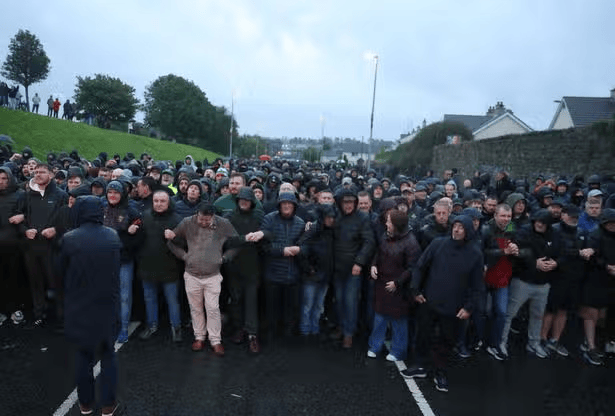
On Friday 25 September 2026, the Parades Commission ruled that Portadown District Loyal Orange Lodge No. 1 could march down the Garvaghy Road for the first time in twenty-eight years.[1] The Commission imposed conditions — thirty-five participants, an early-morning window, silence on the disputed stretch, no bands — but none on the route itself. What followed was a weekend of emergency law and frantic court proceedings. On Saturday afternoon a High Court judge granted the residents an interim injunction and urged the parties to “step back from the abyss”. Shortly before midnight the Court of Appeal, convened in haste, set the injunction aside: the judge had “unfortunately erred in law”, held the Lady Chief Justice, adding, of a determination released after two o’clock on a Friday afternoon, “this cannot happen again”. At a quarter past two on Sunday morning, in a sitting lawyers described as unprecedented, a third judge dismissed the residents’ final challenge.[2] On Sunday morning around two thousand residents of the nationalist end of Portadown simply stood in the road and refused to move. The parade did not go through.[3]
Within hours the familiar choreography of British commentary was underway. Gavin Robinson, the DUP leader, declared: “We are in 2026 and Orangemen walking silently and peacefully down a road should not be a major issue in a shared society.”[4] Northern Ireland’s first minister Michelle O’Neill stated: for twenty-eight years the peace on the Garvaghy Road “was not a problem that required a solution… It was a peace that needed to be protected.”[5] And Andy Burnham, whose government now carries responsibility for all of this, explained why he would do nothing: “the decision has been made – I’m not in a position to cut across the decision because that would be wrong were I to do that.”[6]
Let us be clear about what this episode is, because the press coverage will do everything in its power to make it unclear. This is not a dispute about culture or religious observance, and it is not a “sectarian quarrel” in which both sides are equally ancient and equally unreasonable(as is often argued by the British bourgeois press). It is the attempted reassertion, after twenty-eight years, of a territorial rite — the passage of a lodge of a colonial institution, founded in the pogroms of 1795, through a nationalist community whose existence that institution exists to negate. The march itself is not the point. The route is the point. A parade that can only be meaningful when it passes through someone else’s streets is not a celebration; it is a claim. The fact that this has been resurrected now must be seen in the context of a campaign of destabilisation that is being waged across the occupied six counties that saw another manifestation earlier this year when loyalist mobs with links to narcotics dealers unleashed anti-migrant violence in Belfast. I will return to the reasons for this later in this essay.
II. The Machinery of the Default
The instinct of the serious analyst is to ask who ordered this. There will be no signature on a piece of paper declaring the intentions of those in power. What emerges when we look at the events that led up to this is that it reveals a machine operating in the way it was intended. The GFA put in place a system of government in the occupied six counties which is designed to stabilise British rule. To demonstrate this let us examine what we know about the decision to allow the march.
In August, a Belfast High Court ruling quashed the Parade Commission’s previous determination keeping the parade away from the Garvaghy Road, after the Commission itself conceded a procedural error.[7] The Commission then appointed as mediator a firm — TIDES Mediation NI — whose own client list included the Orange Order; the Garvaghy Road Residents’ Coalition rejected the appointment as non-neutral, and the Commission defended it.[8] Its stated basis for approving the parade was that “the police have no information indicating that this peaceful parade will result in disorder or violence”.[9] Every link in that chain is has the appearance of “neutrality”, procedurally defensible, and politically loaded. The burden of proof runs entirely in one direction: twenty-eight years of imposed peace had to be continuously justified, whereas a single judicial challenge sufficed to reopen the wound. The PSNI intelligence assessment is the real political act here, and it is an act that wears the costume of an absence of information. The legal representation for the residents put this on the record in the weekend’s emergency hearings: nowhere in the PSNI’s contribution to the Commission was there “any assessment of future risk”; it was “entirely directed to past risk”.[10] The “neutral” machinery outsourced neutrality to a company who had the Orange Order on its client roster, and its evidential foundation was an assessment that, on the residents’ counsel’s uncontradicted account, never looked forward at all.
This is the machinery of the Good Friday settlement doing what it was built to do. The settlement outsourced the combustible questions — marches, policing, symbols — to quangos and courts, precisely to depoliticise them. It is very much an agreement of the neo-liberal era in that sense. A “depoliticised” process is never actually neutral though; it is a process whose conservative default always resolves in favour of the beneficiaries of the existing arrangement. You do not need a conspiratorial directorate in Whitehall when the machinery has the bias baked into it. A plot can be exposed, its authors named and shamed. A structural default can only be fought by breaking the structures. These are different struggles, and confusing them is the first service performed, free of charge, by every commentator who describes the Garvaghy Road decision as a “Parades Commission ruling” rather than what it is: the sectarian arrangement of 1921, still governing. Again I must state what must now be obvious about the GFA. It was about stabilising British rule in Ulster. They did this by dealing the nationalist parties into a new governance structure that would include certain rewards for Sinn Fein and the DUP who ultimately emerged as the big winners from this electorally speaking. Just because Michelle O’Neil gets to be first minister though it does not mean that the GFA institutions are any the less about entrenching partition. It just means that a different set of caretakers get to enforce it.
Nor is Burnham’s abdication an accident or a personal failing. “I am not in a position to cut across the decision” is precisely the sentence the system requires of its political class. The civilian politician’s self-disarmament before “independent” processes that the establishment knows exactly how to work is not a malfunction of British democracy. It is one of its load-bearing walls, see also the decision to grant the Bank of England “independence” for another example of how the neo-liberal, post 1989 era saw many decisions taken and placed in a “non political” realm that actually favoured ruling class interests and were made immune to any democratic pressure.
III. The Fifty Years the English Never Saw
To understand the reaction of the residents of Garvaghy Road, and the significance of the provocation, English readers in particular need to reckon with a fact that has been systematically withheld from them: between 1921 and 1968, the six counties were run as a confessional police state operating under the Union flag, and the British mainland was systematically kept in the dark about what went on there.
The record is not subtle if one cares to actually do the research. The pogroms of 1920–22 in Belfast killed hundreds, drove Catholic workers from their jobs in the shipyards and thousands of families from their homes. The Special Powers Act of 1922 — which the Stormont regime retained on its books for half a century — permitted internment without trial, flogging, proscription of organisations, searches without warrant, and was wielded almost exclusively against one community. Proportional representation was abolished in 1929 to entrench unionist one-party rule. Derry, with a nationalist majority, was gerrymandered into permanent unionist control. The Ulster Special Constabulary, known by their more notorious name of the “B-Specials”, was an extremely brutal armed Orange militia wearing a state uniform. In 1935 there were further state sanctioned pogroms. None of this was secret but all of it was rendered invisible to the majority of workers in mainland Britain.[11]
Then came the naming act that completed the concealment: “the Troubles”. By fixing the start of the conflict at 1968 or 1969, the name retroactively converted everything before into a formless prologue of tribal squabbling — the baseline against which the violence of the Irish is measured, while the violence of the state that gassed, interned, shot and colluded its way through three decades is measured against nothing at all. When the civil rights marches of 1968–69 were battered off the road at Burntollet Bridge by the B-Specials and loyalist mobs, and when the RUC exhausted itself attempting to crush the Bogside in August 1969, it was the army that was sent in — on 14 August, not to restrain the garrison but to rescue it. The Hunt Report followed in October; and in November an English chief, Sir Arthur Young of the City of London Police, arrived to disband the B-Specials and re-brand the RUC on London’s terms.[12] First the troops, then a London organised redecoration job. The British state did not descend on the six counties as a neutral peacekeeper between two tribes. It arrived to rescue its own garrison from the people that garrison had been brutalising, and within three years its paratroopers had killed fourteen civilians in Derry, its soldiers had shot ten civilians dead at Ballymurphy — every one of them, the 2021 inquest found, “entirely innocent of any wrongdoing” — and five at Springhill, three of them children and one of them a priest,[13] and its proxy bombers had killed fifteen in McGurk’s Bar.[14]
The bourgeois press did its part with propaganda, then as now. The Irish were “madmen”, religious fanatics who needed to be controlled.[15] This framing did two kinds of work at once: it presented a national and class question as simply inherited tribal madness, so that no one needed to be responsible for it; and it legitimised repression as the keeping of peace between two equivalent savageries. This is how “the troubles” were routinely portrayed in England and this view was never seriously challenged within the labour movement either. Hence the Widgery Tribunal, which took the Army’s word, blamed the dead of Bloody Sunday for their own deaths, and stood as the official truth of the British state for nearly four decades. The Widgery tribunal is the single most instructive document in the whole affair: when concealment failed and the facts threatened to emerge, the state did not apologise. It manufactured better facts — literally manufactured them. The Saville Inquiry later found that Widgery had heard “inaccurate and misleading” evidence from senior army officers, and one former paratrooper testified that the statement he wrote for the tribunal was torn up and replaced by his superiors with one bearing “no relation with fact”.[16] And when the truth finally arrived, in the form of the Saville Report — the killings “unjustified and unjustifiable”, as the Prime Minister conceded in the Commons — the state accepted the findings solemnly, promised the families accountability, and then made sure there was none.[17] One paratrooper, “Soldier F”, was eventually charged; the government spent over £4 million of public money on his defence; and on 23 October 2025 he was acquitted on all counts, the judge holding that the Crown’s evidence fell “way short” — while adding that those involved in the shootings “should hang their heads in shame”.[18] An apology that binds the apologiser to nothing is not an apology. It is the concealment, continued by other means.
Nor has this machine retired. On 30 April 2026 the coroner in the Springhill inquest — an inquest heard against the clock, its hearings completed hours before the Legacy Act’s cut-off shut down all such inquiries for good — found that all five dead had been shot by soldiers of the 1st Kings Regiment; that the force used was unreasonable; that the victims, three of them children and one of them a priest, had posed no threat; and that “much of the military evidence presented to the inquest was false”.[19] Fifty-four years on, the same military evidence, manufactured in the same way. It is one machine, and it is still running.
And where the official state needed deniability, it had (and still does have) the loyalists. Here we must introduce an understanding of loyalism that goes beyond the borders of the occupied six counties, Empire loyalism is what operates here and its centre is the crown with the officer corps and intelligence men operating as its enforcers regardless of what the elected government wants: the Curragh mutiny of 1914, when an officer corps mutiny dictated policy to a majority Liberal government; the Larne gun-running, executed with open military connivance; the Ulster Workers’ Council strike of 1974, which brought down the Sunningdale executive by force and vetoed British policy outright.[20] Nor was it command at all, in the sharp-end sense. It was loyalism operating as a system. The Ulster Defence Regiment (UDR) was drawn almost entirely from the Protestant population — a 1973 British military intelligence assessment, entitled Subversion in the UDR, estimated that between 5 and 15 per cent of its soldiers were simultaneously members of the terrorist Ulster Defence Assocation (UDA) or other loyalist paramilitary organisations, recorded “widespread joint membership of the UDA”, noted that commanders treated dual membership as normal, and warned that the primary loyalty of many members was to “Ulster” rather than to the British government.[21] The Glenanne Gang operated across the RUC, the UDR and loyalist paramilitaries with a reach that included bombings in Dublin and Monaghan — killings the Barron inquiry indicated involved security-force personnel.[22] The Stevens inquiries documented collusion systematically; the de Silva review found that 85 per cent of the UDA’s intelligence came from security-force sources; and the Force Research Unit ran agents on all sides because “all sides” was always a fiction: at the sectarian edge, the state forces and the lodge were one body.[23]
The Ulster Volunteers of 1912, the B-Specials of 1922, the UDR of 1970, the “community representatives” of the Parades Commission’s mediation process of 2026 — this is a single institution, changing its dress as circumstances require. Iain Paisley senior, meanwhile, served his usual function as the alibi: blame the bigot, the personality, the old time Bible thumper, and you never have to name the structure. The bigotry was never marginal to the Orange state. The Orange state was the institutional form of the bigotry.
IV. James Connolly’s Analysis of Orangeism
There is no better guide to what happened on the Garvaghy Road than a man who has been dead for 110 years and paid the ultimate price in the Irish liberation struggle. James Connolly was born in Cowgate, Edinburgh, the son of Irish immigrants; he had served as a soldier of the Crown in Ireland, deserted, and returned to organise the Irish Transport and General Workers’ Union in Belfast from 1911 following several years in the USA working with the IWW. He knew the Orange Order not as a sociological curiosity but as the principal organised obstacle between Protestant and Catholic workers — and he wrote about it with a precision that has never been superseded.
His essay “July the 12th”, written for the Glasgow socialist paper Forward in 1913, is the Twelfth anatomised. Connolly does not begin with denunciation; he begins with observation, and lets the facts convict. He notes the walls of Belfast inscribed “God is Love” above “Hell Roast the Pope”, and draws the conclusion that matters: the contradiction is not accidental, it is the content. He then turns to the mythology. The Orangemen march to celebrate the Boyne as a victory for civil and religious liberty; Connolly reminds his readers that King William fought the battle subsidised by the Pope, his ally in the League of Augsburg, that a Te Deum was sung in Rome for his victory, and that “on Saturday the Orangemen of Ulster, led by King Carson, will be celebrating the same victory as the Pope celebrated 223 years ago.” The point is not pedantry. It is that the mythology survives only because the truth is “slurred over” — and that slurring is a political practice with a political purpose.[24]
But it is his account of the Plantation itself that speaks most directly to Portadown in 2026. The land of Ulster, Connolly insists, was not given to the Scottish settlers. “The land was given to the English noblemen and to certain London companies of merchants who had lent money to the Crown, and… the Scottish planters were only introduced as tenants of these landlords. The condition of their tenancy virtually was that they should keep Ireland for the English Crown, and till the land of Ireland for the benefit of the English landlord.” Then the sentence that could have been written this weekend, about this march: “That is in essence the demand of the Unionist Party leaders upon their followers today.”[24]
From that fact Connolly derives the whole strategic analysis. The descendants of the persecuted Presbyterians — persecuted for generations by the very Episcopalian establishment now celebrated as their co-religionists — are bound to their landlords and capitalists by a sectarian tie that is specifically designed to obscure class divisions between them:
the landlord and capitalist class now seek an alliance with these Protestants they persecuted for so long in order to prevent a union of the democracy of all religious faiths against their lords and masters. To accomplish this they seek insidiously to pervert history, and to inflame the spirit of religious fanaticism.[24]
Read that again, and then read Gavin Robinson on the Garvaghy Road — “Orangemen walking silently and peacefully down a road” — with the march’s history surgically removed, its symbolism abstracted into a simulacrum of harmless cultural practice. “Insidiously to pervert history, and to inflame the spirit of religious fanaticism”: Connolly described the method in 1913, and it is the method still. His line on the marchers themselves lands with equal force a century on: thousands who march to proclaim their allegiance “to principles of which their order is a negation”.[24]
When partition was proposed the following year, Connolly produced the judgement against which everything since must be measured. The betrayal, he wrote, “would mean a carnival of reaction both North and South, would set back the wheels of progress, would destroy the oncoming unity of the Irish Labour movement and paralyse all advanced movements whilst it endured. To it Labour should give the bitterest opposition, against it Labour in Ulster should fight even to the death, if necessary, as our fathers fought before us.”[25] The partition went ahead anyway — imposed, as we have seen, at the point of the Carsonite gun — and carnival of reaction predicted by Connolly arrived on schedule: the Orange statelet in the north, the church-dominated bourgeois state in the south, and an Irish labour movement paralysed by division for a century. Drumcree 2026 is not a new chapter. It is the carnival, continuing.
In August 1914 Connolly let the Carsonites indict themselves, in words that anticipate with uncanny accuracy the proprietary mentality this essay returns to below:
The Carsonites say that their fathers were planted in this country to assist in keeping the natives down in subjection that this country might be held for England… Therefore, say the Carsonites, we have kept our side of the bargain; we have refused to admit the Catholics to power and responsibility; we have manned the government of this country for England, we propose to continue to do so, and rather than admit that these Catholics – these ‘mickies and teagues’ – are our equals, we will fight, in the hope that our fighting will cause the English people to revolt against their government and re-establish us in our historic position as an English colony in Ireland, superior to, and unhampered by, the political institutions of the Irish natives.[26]
An English colony in Ireland, superior to, and unhampered by, the institutions of the natives: there, in the Carsonites’ own mouths, is the private fiefdom. And Connolly identified the formula that held the whole position together — “the dominant note of all their speeches, sermons and literature”: “We are loyal British subjects. We hold this country for England. England cannot desert us.”[26] Hold it for England: the crown-loyalism to which this essay turns below was never an ornament on the proprietary claim. It was the claim’s legal form.
Connolly’s final word on the whole edifice, given in his last statement to the field general court martial at Dublin Castle and entrusted to his daughter Nora on 9 May 1916, three days before the firing squad in Kilmainham, has never been answered, only ignored:
Believing that the British Government has no right in Ireland, never had any right in Ireland, and never can have any right in Ireland, the presence, in any one generation of Irishmen, of even a respectable minority, ready to die to affirm that truth, makes that Government for ever a usurpation and a crime against human progress.[27]
He died, in Connolly’s own formulation, for the proposition that the cause of labour is the cause of Ireland and the cause of Ireland is the cause of labour. “They cannot be dissevered.” It is worth adding that on the green flag itself he was characteristically exact: “For centuries the green flag of Ireland was a thing accurst and hated by the English garrison in Ireland, as it is still in their inmost hearts.”[28]
V. Loyalism and the Crown
Which brings us to the question that must now be asked plainly. What is loyalism? Is it just the Ulstermen of the Orange Order and their allies? Their Scottish cousins? The English followers of Yaxley Lennon? The military hierarchy? Their friends and backers in the ultra-reactionary wing of the British ruling class? It is all of these — and it is more than their sum. They are, above all, empire and crown loyalists. And that is not a species of their politics. It is the definition of it.
Start with the name. The first “loyalists” in political history were not Orangemen but the United Empire Loyalists of the American revolution — those who chose the Crown against the republic and were resettled in Canada as a reward for their fidelity.[29] The term entered politics meaning exactly what it still means: the party of the empire against the nation. The Ulster Covenant of 1912 was sworn to King George V, not to any principle. The UVF drilled in the Crown’s name. The Orange Order is, structurally, a crown cult — its founding myth is tied to a monarch, its regalia are royalist regalia, its members explicitly defenders of the crown. Carson’s movement was a monarchist insurrection against an elected parliament. So when the lens widens, the category holds perfectly: the Twelfth in Portadown, the lodge rooms of Larkhall, the union-flag regalia of the English street movement, the officers’ mess, the clubland set — these are not similar movements with a family resemblance. They are one movement, locally differentiated, whose binding agent is the Crown.
Nor is the monarchy merely decorative in this structure. The English constitutionalist Walter Bagehot taught the ruling class the trick a century and a half ago: the British system possesses, he argued, a “dignified” part of the constitution “to exalt and excite”(the crown), an “efficient” (parliament, the civil service etc) part to govern.[30] The proper Marxist reading of that divisionis more accurate. The “dignified” part exists precisely to be the reserve of reaction. Consider the oath structure, the material fact under all the nauseating pageantry. Members of the armed forces swear allegiance to the monarch — not to Parliament, not to any constitution, neither of which binds them. Police constables swear to “well and truly serve the King in the office of constable”; the civil service is literally “His Majesty’s” and its employees defined as “crown servants”. The royal prerogative — war, treaties, dissolution, prorogation, and the whole domain of “national security” that no court and no devolved administration can reach — is exercised in the Crown’s name, which in practice means by whoever can get their hands on it.[31] There is no constitutional patriotism anywhere in the British state machine because the machine is not built around a constitution. It is built around an office, hereditary and unaccountable, deliberately placed above every authority that could possibly be elected and look to act against the interests of the ruling class.
The proof that this is not antiquarianism is that the reserve has been used repeatedly. In March 1914 the officer corps refused the elected government’s orders and suffered no consequence, because its ultimate loyalty was to the Crown — the Home Secretary’s writ simply stopped at the door to the officers mess, and the government dutifully capitulated.[32] In 1932 the Governor of New South Wales dismissed Jack Lang’s elected government; in 1975 Governor-General Kerr dismissed Australian Prime Minister Gough Whitlam, and the Palace letters released in 2020 confirmed that Buckingham Palace was managing the crisis while publicly pretending constitutional neutrality — the “dignified” part pulling strings the “efficient” part would be blamed for. In 2008 the Crown prorogued the Canadian Parliament to save a government from defeat. In 2019 the prerogative of prorogation was used to try to disable Parliament, and was stopped only by an unprecedented Supreme Court ruling — the Scottish Court of Session having got there first — which tells you both that the tool exists and that openly deploying it now carries costs, which is why the modern crown prefers to govern through “independent” commissions and quangos rather than through its own hand.[33] The reserve is always there though, ready to be deployed if the crisis is severe enough and the threat is perceived as necessitating it.
One qualification must be made, because the error of conspiracy-thinking lurks here as it does everywhere in this subject. The crown is not the directorate of reaction. It is the condensation point — the symbolic apex and constitutional alibi under which the disparate forces listed above assemble. Its power is real but relational: it binds the officer’s oath, sanctifies the garrison, dignifies the gentleman’s clubs where plots are hatched, and gives the whole structure a flag that no election can remove. Lenin’s definition of the state — a body of armed men — needs its British corollary: a body of armed men whose oath runs to a hereditary crown, and whose reserve weapon is therefore permanently to hand regardless of what any election result produces.[34]
There is a grotesque coda to all this and it relates to the Irish Republic. In the twenty-six counties, a new generation of reactionaries — the “Irish” far right — has taken to proclaiming solidarity with its “Christian brothers” in the Orange Order. The Order’s foundational rites celebrate the defeat of the very church to which these reactionaries belong; their grandfathers’ Ireland was the thing the Order was built to exclude. But coherence has never been the requirement of reaction, only amnesia. The modern monarchy’s survival strategy has been to appear to shed its actual powers and persist as pure sign — and it is precisely that emptiness which makes it the perfect rallying point, a floating signifier onto which anything can be projected. “King and Country” can mean the Somme, it can mean Portadown 2026, it can mean a march through a Lancashire market town — and it can be clasped, in an absurd display, by descendants of men the same Crown once hanged in Kilkenny and Cork. A sign emptied of every historical referent can be worn by anyone, and reaction always prefers a sign to an argument. Historical amnesia is not a side effect of reaction. It is its precondition. Connolly, whose method was the relentless reconnection of symbols to the material interests they serve, would have recognised the phenomenon instantly: the sign, cut loose from its referent, can be made to mean anything, and frequently is.
VI. The Proprietary Caste
Connolly’s “historic position as an English colony in Ireland” — superior, unhampered — is not a rhetorical exaggeration. It is a mentality that is genuinely difficult for people who have not encountered it to credit, and it is worth taking seriously, because it has shaped events far more than any parliamentary calculation.
Anyone who has spent time around certain sections of the British bourgeoisie — the military families, the clubland reactionaries, the colonial administrative class — will recognise it. Ireland is not a policy question to these people. It is a property that was partially lost, a fiefdom repossessed by its tenants. The nominal independence of the twenty-six counties was experienced by this caste as theft, and the prospect of losing the remaining six registers with them as an intolerable precedent: proof that a settler garrison can be negotiated off its territory, that the Crown’s writ can be withdrawn by arithmetic. In 1912–14 the British ruling class as such was prepared to tolerate Home Rule — rule through finance and trade would have continued perfectly well. What Home Rule could not survive was the armed refusal of the officer corps and the UVF, and Asquith’s majority government capitulated to both — a capitulation that makes sense only once the oath structure described above is understood: the officers were not defying their sovereign, they were claiming to serve him more truly than his ministers did. Attlee’s 1949 Ireland Act, entrenching the unionist veto,[35] was the same lesson applied by a Labour government: no British administration has ever faced this caste down, because the caste runs the agencies — military and intelligence — through which force is actually organised. This caste commands the bodies of armed men upon which the British state must depend and its gives them power that no politician wants to reckon with. This is why a British general can casually make threats of mutiny in relation to the potential of a Corbyn led government and suffer no consequences.
This is the point at which a certain kind of Marxist analysis of the British state does fall short, and it is worth saying plainly why this is the case. The British state is not a single instrument obedient to the general interests of British capital. On Ireland it is better understood as a field of forces containing a veto player of unusual determination, whose institutional existence — the garrison, the intelligence architecture, the integration of the six counties into the armed forces’ own self-conception — does not depend merely on profit and loss. Sections of British capital would take a united Ireland inside the Euro-Atlantic and NATO framework without blinking. What cannot be permitted is not a united Ireland as such, but the demonstration that unity can be achieved by consent against the wishes of the garrison. That precedent — the settler-redoubt precedent — is what must be made unthinkable, and the method is not legal prohibition but functional veto: keeping the loyalist capacity ready to be deployed, keeping the cost of Irish unity high, ensuring that any transition arrives accompanied by orchestrated, violent destabilisation which no Dublin government really wants to deal with. The Good Friday commitment to a border poll is real, and irrelevant to the method. You do not need to forbid a vote that you have made too dangerous to win.
Which is why the timing of Drumcree 2026 is not nostalgia but arithmetic. A border poll within a generation is a real prospect,[36] and the reassertion of the territorial rite is best read as pre-emptive terror management — the claim restated while it can still be restated. The fever dreams of the British officer caste will never be realised; they will never march back to Dublin. But they do not need to be realised to be effective. They need only to be shared by enough of the people who run the army, the intelligence services, and the “independent” processes that ministers are so careful never to cut across.
VII. The Scottish Garrison
At this point the story acquires its most instructive contemporary turn, because the repression of the Garvaghy Road was staffed, in part, from Scotland.
Around one hundred officers of Police Scotland were sent to the six counties under “mutual aid” arrangements[37] — the second such deployment in fifteen months, following the dispatch of Scottish officers to Ballymena in June 2025.[38] Note carefully how the decision is described by those who made it. A Police Scotland spokesperson explained: “As a national service, Police Scotland has the ability to flex resources where the need is greatest.”[39] A national service. National to whom? The force of a devolved administration, describing itself as a component of a national — that is, British — service, flexing resources toward a need defined by the PSNI and the Parades Commission, with no Scottish political decision-maker claiming responsibility for the decision at any point in the chain. London did not need to order it. Holyrood did not debate it and the First Minister of Scotland pointedly evades the issue. The Chief Constable decided it, in the depoliticised language of operational independence, and the Scottish Government gets the best of both worlds: no fingerprints, no accountability, and a standing arrangement by which the coercive resources of Scotland can be surged into the Ulster garrison on request.
The readers should pause on the quiet scandal this represents, because it dissolves the comfortable story told by all parties. The unionist story says the union is safe; the SNP story says Scotland’s institutions are Scotland’s. Both stories depend on not examining what actually happened this weekend. For all the talk of devolution, the coercive core of the Scottish state — its police as a reserve pool, its territory as a nuclear station, its population as a recruiting and drafting ground — remains integrated into the British whole, governed by arrangements that no Scottish voter will ever been asked to approve and no Scottish minister will ever try and change whilst the craven collaborators of the SNP continue to rule. A Scottish constable’s liability to serve in the six counties, of the kind this writer’s father signed up to in an English police contract in 1977 and which remains in force today, is a small legalistic inscription of that integration. The garrison does not need to command Scotland’s police. It needs only for Scotland’s police to think of themselves, in their own official words, as a British national service loyal to the crown. Then the obedience is voluntary, automatic, and deniable all at once.
The Irish community in Scotland has noticed, and said so: what, asked the campaign group Call It Out, will the presence of Scottish police officers on the Garvaghy Road do “to trust among Irish communities in Scotland”?[40] It is a question with deep roots. Scottish participation in the Orange-colonial project did not begin this weekend. The Plantation of Ulster was substantially a lowland Scottish settler project; the Orange Order’s largest presence outside the six counties is in the west of Scotland; the UVF of 1912 was armed and cheered from the Presbyterian westof Scotland; Scottish regiments garrisoned Ireland for centuries. Scottish police officers standing on the Garvaghy Road in 2026 are not an anomaly requiring a London directive to explain. They are the diasporic garrison continuing its ancestral function, and in the housing schemes of Glasgow and Portadown alike, everyone involved knows exactly what is being continued, even — especially — when the official language is the deliberately bloodless vocabulary of mutual aid.
IX. The Good Friday Agreement: A Change in Management
The agreement that underpins how this whole affair has been managed must also be examined at this stage. This agreement was put in place at a time both Britain and Ireland were experiencing times of growth, the time of neo-liberal optimism regarding future EU integration. Now, 18 years after the crisis of 2008, not only is the growth all gone but the British and Irish economies offer nothing to the working class even compared to the 1990s. The relative stability of the late 1990s is long gone. The EU is being led towards militarisation and the diminishing of the social model that many thought it came with. Prospects for the working class across all of Ireland are increasingly grim and they are not that much better across Britain either. The escalating crisis will reveal what has always been fundamentally true about the Good Friday Agreement. The British reactionaries swallowed it because it didn’t actually threaten control over Ulster. What it did was transfer the management of the occupied six counties to new governors including the nationalists of Sinn Fein. The Sinn Fein plan for a unified Ireland, if we are to take them seriously, seems to be to secure a united Ireland inside the EU and NATO. Clearly they expect that this way they can override the loyalist veto power as it will get the US imperialists on side. This should not be counted upon though and a united Ireland inside an imperialist bloc with its economic and security policies set in Berlin, Brussels, London or Washington will be exactly the kind of “independence” that Connolly warned of all the way back in 1897 in his work Socialism and Nationalism
If you remove the English army to-morrow and hoist the green flag over Dublin Castle, unless you set about the organisation of the Socialist Republic your efforts would be in vain.
England would still rule you. She would rule you through her capitalists, through her landlords, through her financiers, through the whole array of commercial and individualist institutions she has planted in this country and watered with the tears of our mothers and the blood of our martyrs.
England would still rule you to your ruin, even while your lips offered hypocritical homage at the shrine of that Freedom whose cause you had betrayed.[41]
Replacing domination by England with domination by either America, Germany or France is a paltry, withered vision of a nation. It mirrors what has been done to the Irish Republic which has been turned into a tax haven for tech companies following the crash of the property boom after the crisis of 2008. At this stage I recall some great verse from the late Luke Kelly which went as follows
Was it greed that drove Wolfe Tone to a pauper’s death in a cell of cold wet stone?
Will German, French or Dutch inscribe the epitaph of Emmett?
When we have sold enough of Ireland to be but strangers in it
For what died the sons of Róisín, was it greed?
Luke Kelly – For What Died The Sons Of Roisin
The reason all of this has relevance to the question of the border poll is that the crown loyalists have made it clear that they can and will cause trouble in the event of one even being threatened. An Irish government wedded to American and European capital, that desires nothing but to create a safe environment for that capital to invest (or have a postal address) in Ireland has no stomach for the trouble the crown loyalists could create. This is not, as some will claim, a call to go back to the old days or armed struggle. What is needed though is a determined working class led movement for Irish freedom rather than the thin NATO gruel offered by Sinn Fein.
VIII. What is to be learned
The cause of labour is the cause of Ireland, the cause of Ireland is the cause of labour, and they cannot be dissevered — James Connolly’s formula, and the thread of this whole essay. Marx had reached the same conclusion from the opposite direction half a century earlier: “The English working class will never accomplish anything before it has got rid of Ireland. The lever must be applied in Ireland.”[42] Marx went onto say “This is why the Irish question is so important for the social movement in general”.
Lenin put the operative point more sharply, in the weeks after the Easter Rising was drowned in blood: “To imagine that social revolution is conceivable without revolts by small nations in the colonies and in Europe, without revolutionary outbursts by a section of the petty bourgeoisie with all its prejudices… to imagine all this is to repudiate social revolution.” The outbursts of national wrath are not distractions from the class struggle but constituent parts of it — and for this essay’s subject Lenin had a still more exact sentence: a blow delivered against the power of the English imperialist bourgeoisie by a rebellion in Ireland is “a hundred times more significant politically than a blow of equal force delivered in Asia or in Africa”.[43] And John Maclean issued the same indictment from Glasgow in 1920, in a pamphlet addressed to the Scottish working class: “My plea is that Britain has no right to dominate Ireland with constabulary armed with bombs, and with an army and navy considered foreign by the Irish.”[44]
The residents of the Garvaghy Road did not read out these texts on Sunday morning. They simply stood in their road, around two thousand of them, and refused. That refusal was, among other things, a service performed for the British working class — for the English worker kept in manufactured ignorance for fifty years, for the Scottish worker whose police are sent to do work no one will answer for, for everyone on these islands whose emancipation is obstructed by the same apparatus that polices the march routes of Portadown. For that apparatus has a keystone, and it is not in Portadown, or London, or Edinburgh, but in the institution to whom the soldier, the sailor, the airman, and the constable all swear their oath — a hereditary sovereign, above every election, holding the armed power of the state in reserve against the day the propertied class require it to be deployed. The Ulster garrison endures because it is hidden, and because at its head stands a sign before which parliaments are trained to bow. The first duty remains the old one: to drag it into the light, and to refuse — in Burnham’s contemptible formula — to accept that anyone is “not in a position” to cut across it.
The solution for all of this is to make the cause of Ireland the cause of Labour again. The British occupation of the north has gone back to being buried as an issue in the British bourgeois press. Not only must we drag it into the light but we must also stand in solidarity with the Socialist Republicans of all of Ireland who wish to fight for a unified socialist country freed of the carnival of reaction that Connolly knew would come from partition.
Footnotes
1. Parades Commission determination, 25 September 2026; Irish Times, “Orange Order granted permission to march down Garvaghy Road for first time since 1997”, 25–26 September 2026. The last Orange march forced down the Garvaghy Road was in July 1997; the route was closed to the Order from 1998 — hence the First Minister’s “twenty-eight years”.
2. Irish Times courts coverage, 27–28 September 2026: Smyth J’s interim injunction (“step back from the abyss”); Court of Appeal sitting c. 11.30pm, Keegan LCJ holding that the judge had “unfortunately erred in law” and adding: “there is a major problem that the decision in this case was given after 2pm on a Friday afternoon. This cannot happen again.”; RTÉ News, “Garvaghy Road march to go ahead after legal challenge”, 27 September 2026: Humphreys J dismissed the residents’ challenge at 2.15am, in a sitting described as unprecedented.
3. Reuters, 27 September 2026: “Around 2,000 protesters blocked a Protestant parade from marching through the Catholic area”; BBC News live coverage, 27–28 September 2026 (the parade did not take place after protesters blocked the route); Belfast Telegraph, 27–28 September 2026: “PSNI says Drumcree parade cannot be facilitated”.
4. Gavin Robinson MP, leader of the Democratic Unionist Party, quoted in the Irish Times, 26 September 2026.
5. Michelle O’Neill, statement, Sinn Féin press release, “Michelle O’Neill responds to the decision to force Orange march through Garvaghy Road”, 25–26 September 2026.
6. Andy Burnham interviewed on UTV; reported in RTÉ News, “As it happened: Drumcree march condemned by Sinn Féin”, 25–26 September 2026.
7. BBC News, “High Court quashes decision to restrict Orange Order parade”, 25 August 2026; Irish Legal News, 26 August 2026. McAlinden J quashed the earlier determination after the Commission conceded a procedural error; its procedures were described as “sloppy”.
8. Irish News, “Garvaghy Road residents reject Drumcree mediator over concerns it worked for Orange Order”, 17 September 2026; BBC (Nolan), 18 September 2026 — the Commission defended the appointment; TIDES’ client list included the Orange Order, the GAA and the UN. The residents’ letter also reminded the Commission of “the 21 deaths caused between July 8 1996 and June 5 1999 as a result of the ‘Drumcree Conflict’”.
9. Parades Commission determination, 25 September 2026, as quoted by Gavin Robinson in the Irish Times, 26 September 2026.
10. Denise Kiley KC, for the residents, reported in ITV/UTV court coverage of the emergency hearings, 26–28 September 2026.
11. Michael Farrell, Northern Ireland: The Orange State (Pluto Press, 1976; 2nd ed. 1980); Report of the Cameron Commission, Disturbances in Northern Ireland (Cmd 532, HMSO 1969), full text on CAIN (cain.ulster.ac.uk/hmso/cameronx.htm) — discrimination in housing, public appointments and electoral boundary manipulation “well documented in fact”; the B-Specials “a partisan and paramilitary force recruited exclusively from Protestants”.
12. Report of the Scarman Tribunal, Violence and Civil Disturbances in Northern Ireland in 1969 (Cmd 566, HMSO 1972) — the RUC “seriously at fault” on at least six occasions; the USC “totally distrusted by the Catholics, who saw them as the strong arm of the Protestant ascendancy”. The army deployed on 14 August 1969; the Hunt Report was published in October 1969; Sir Arthur Young, seconded from the City of London Police, took up the post of Inspector-General of the RUC in November 1969 and disbanded the B-Specials (Oxford Dictionary of National Biography, “Young, Sir Arthur”; CAIN chronology).
13. Ballymurphy inquest findings, May 2021: ten people shot dead, all found “entirely innocent of any wrongdoing”; an eleventh man died of a heart attack following a confrontation with soldiers. Springhill, 9 July 1972: five dead — Margaret Gargan (13), John Dougal (16), David McCafferty (15), Fr Noel Fitzpatrick and Patrick Butler.
14. Police Ombudsman for Northern Ireland, public statement on the McGurk’s Bar bombing, 21 February 2011: “investigative bias”, including selective briefings to government and media blaming the IRA for what was in fact a loyalist bomb — while concluding that this bias “fell short of collusion” and finding no evidence that the RUC assisted the bombers; ITV News, 19 May 2022: the PSNI conceded that the Historical Enquiries Team’s “no bias” finding was irrational; Declassified UK, “Blaming the victims: the McGurk’s bar bombing” (2022): the 39 Brigade log and the document signed by Edward Heath attributing the bombing to the IRA. For the wider record on which “proxy” rests, see notes 21–23 below.
15. Liz Curtis, Ireland: The Propaganda War (1984; revised ed. 1998).
16. Report of the Bloody Sunday Inquiry (Saville, HC 29, 15 June 2010), on the Widgery Tribunal (HL 101, April 1972): Widgery heard “inaccurate and misleading” evidence from senior army officers; one former paratrooper testified that the statement he wrote for Widgery was torn up and replaced by his superiors with one bearing “no relation with fact”.
17. David Cameron, House of Commons statement on the publication of the Saville Report, 15 June 2010 (full text on CAIN).
18. The Guardian, “British army veteran known as Soldier F not guilty of Bloody Sunday murders”, 23 October 2025 (Mr Justice Lynch; “should hang their heads in shame”); UK parliamentary answer to Colum Eastwood MP on the cost of Soldier F’s defence (over £4 million).
19. Springhill Inquest, findings of Mr Justice Scoffield, [2026] NICoroner 2, 30 April 2026 (judiciaryni.uk/springhill-inquest): soldiers of 1st Kings Regiment firing from Corry’s Timber Yard; the force used unreasonable; the victims posed no threat; “much of the military evidence presented to the inquest was false”. The inquest’s hearings concluded hours before the cut-off imposed by the Northern Ireland Troubles (Legacy and Reconciliation) Act 2023, which shut down all such inquests.
20. A.T.Q. Stewart, The Ulster Crisis: Resistance to Home Rule, 1912–14 (Faber, 1967); on the UWC strike, Robert Fisk, The Point of No Return: The Strike which Broke the British in Ulster (1975), and the CAIN chronology.
21. “Subversion in the UDR”, British military intelligence paper prepared for the Joint Intelligence Committee, 1973; publicised in Micheál Smith, UDR Declassified (2022) and the Irish Times, 9 April 2022.
22. Oireachtas Joint Committee, Interim Report of the Independent Commission of Inquiry into the Dublin and Monaghan Bombings (Barron Report), December 2003; Anne Cadwallader, Lethal Allies: British Collusion in Ireland (Mercier Press/Pat Finucane Centre, 2013). It should be noted that the final report of the Operation Denton review (9 December 2025) found no evidence of security-force collusion in the Dublin–Monaghan bombings specifically, while confirming the Glenanne gang’s composition — UVF, RUC and UDR personnel — and its links to 127 sectarian murders.
23. Stevens Inquiry 3, Overview & Recommendations, 17 April 2003 (text on CAIN); Sir Desmond de Silva QC, The Pat Finucane Review (HC 802, December 2012) — 85 per cent of UDA intelligence originated from security-force sources; Operation Kenova Interim Report, 8 March 2024, and Final Report 2025 — on the FRU-run agent “Stakeknife”: the agent operation was “likely to have cost lives”, and the government continues to refuse to name him (Northern Ireland Affairs Committee, “Operation Kenova: naming Stakeknife”, February 2026).
24. James Connolly, “July the 12th”, Forward, 12 July 1913, Marxists Internet Archive: marxists.org/archive/connolly/1913/07/july12.htm. All quotations in this section follow the MIA text.
25. James Connolly, “Labour and the Proposed Partition of Ireland”, Irish Worker, 14 March 1914, Marxists Internet Archive: marxists.org/archive/connolly/1914/03/laborpar.htm. See also Fergal McCluskey & Brian Kelly, “A ‘Carnival of Reaction’: Partition and the Defeat of Ireland’s Revolutionary Wave”, Irish Marxist Review 4:14 (November 2015), Marxists Internet Archive.
26. James Connolly, “The Carsonite Position”, Irish Worker, 8 August 1914, Marxists Internet Archive: marxists.org/archive/connolly/1914/08/carson.htm. The block quotation follows the MIA text with one ellipsis; also quoted in McCluskey & Kelly, ibid.
27. James Connolly, Last Statement, addressed “To the Field General Court Martial, held at Dublin Castle, on May 9th, 1916” and given to his daughter Nora Connolly on the eve of his execution, 9 May 1916; Connolly was shot on 12 May. Marxists Internet Archive: marxists.org/archive/connolly/1916/05/laststat.htm.
28. James Connolly, “The Irish Flag”, Workers’ Republic, 8 April 1916, Marxists Internet Archive: marxists.org/archive/connolly/1916/04/irshflag.htm — source both of “the cause of labour is the cause of Ireland… They cannot be dissevered” and of the “thing accurst” passage.
29. On the United Empire Loyalists: Parks Canada and The Canadian Encyclopedia.
30. Walter Bagehot, The English Constitution (1867), ch. II.
31. Armed Forces Act 2006 (oath of allegiance to the monarch); Police Act 1996, Schedule 4 (attestation: “I will well and truly serve the King in the office of constable”), with the PSNI equivalent; civil service Crown status; the prerogative powers over war, treaties and prorogation.
32. On the Curragh and Larne, see note 20 above.
33. On Lang: Australian Dictionary of Biography, “Lang, John Thomas”, and NSW State Archives (dismissed 13 May 1932). On Whitlam: the “Palace Letters”, National Archives of Australia, released 14 July 2020 after Hocking v Director-General of the National Archives of Australia [2020] HCA 19. On Canada: prorogation of 4 December 2008. On 2019: R (Miller) v The Prime Minister; Cherry v Advocate General for Scotland [2019] UKSC 41 — prorogation unlawful, void and of no effect; the Inner House of the Court of Session had reached the conclusion first.
34. V.I. Lenin, The State and Revolution (1917), Marxists Internet Archive — the state as “special bodies of armed men”.
35. Ireland Act 1949, s. 1(2): “in no event will Northern Ireland or any part thereof cease to be part of His Majesty’s dominions and of the United Kingdom without the consent of the Parliament of Northern Ireland”.
36. NISRA, Census 2021 main statistics, published 22 September 2022: 45.7 per cent of the population Catholic or brought up Catholic, against 43.5 per cent from a Protestant or other Christian background — the first such reversal since partition (BBC News; Financial Times, 22 September 2022). Border-poll mechanism: Northern Ireland Act 1998, Schedule 1.
37. Irish News, 25–26 September 2026: around 100 Scottish officers expected; Police Federation for Northern Ireland chair Liam Kelly: “Services in Scotland and England and Wales have answered the call”; PSNI strength 6,444 with around 4,000 deployable. One broadcast report put the figure nearer 200; around 100 is the documented figure, also used by Call It Out (note 40).
38. BBC News, “Scottish police sent to Ballymena after help plea”, 11 June 2025; PSNI statement, 11 June 2025: “I will be making arrangements to activate mutual aid resources” — 80 officers requested from forces in Great Britain.
39. Police Scotland statement, quoted in the Daily Record, “Scots cops to be sent to Northern Ireland to police Orange Order parade”, 26 September 2026. The full statement continues: “…and we routinely deploy police officers to operations across the UK.”
40. Call It Out statement, quoted in the Daily Record, 26 September 2026: “Garvaghy Road has not seen the forced Orange Order march… Police Scotland should understand exactly what it is stepping into… deploying 100 officers to facilitate this march is an extraordinary intervention in a post-conflict society it does not routinely police… Where, then, are the rights and dignity of Garvaghy Road’s Irish nationalist residents in its assessment? And what will this do to trust among Irish communities in Scotland?”
41. James Connolly Socialism and Nationalism, Shan Van Vocht, January 1897 – Taken from the Marxist internet archive – https://www.marxists.org/archive/connolly/1897/01/socnat.htm
42. Karl Marx to Friedrich Engels, 10 December 1869, Marx–Engels Correspondence (MECW vol. 43), Marxists Internet Archive.
43. V.I. Lenin, “The Discussion On Self-Determination Summed Up” (written July 1916; published October 1916), §10, “The Irish Rebellion of 1916”, Marxists Internet Archive: marxists.org/archive/lenin/works/1916/jul/x01.htm. The first quotation is trimmed with an ellipsis; the second is verbatim.
44. John Maclean, The Irish Tragedy: Scotland’s Disgrace (1920), Marxists Internet Archive: marxists.org/archive/maclean/works/1920-tit.htm.


Leave a Reply